
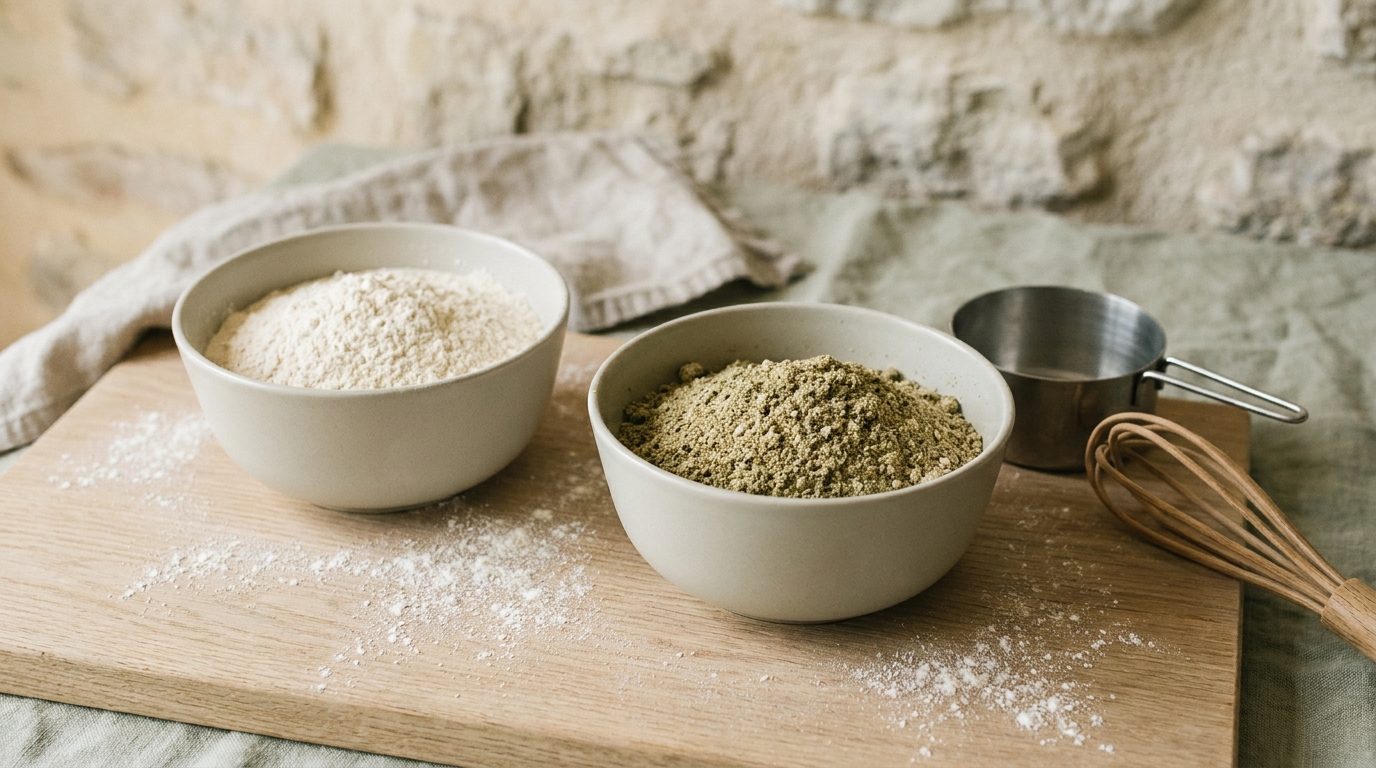
No, you cannot swap hemp flour for regular flour one-to-one and expect a good result. Hemp flour has no gluten, absorbs liquid differently, and carries far more protein and fibre than wheat, so a straight 1:1 swap turns out dense, crumbly, and prone to falling apart. The honest answer is a range that depends entirely on what you are baking, and this guide gives you the exact percentage and the liquid math for each.
Why a 1:1 swap fails
Wheat flour does one thing no other flour does as well: it forms gluten. When wheat flour is hydrated and worked, two proteins (glutenin and gliadin) link into an elastic network that traps gas from yeast or leavening, stretches as the dough rises, and sets into a structure that holds its shape. That network is the scaffolding of almost every familiar baked good.
Hemp flour brings none of this. It is the milled cake left after hemp seed oil is pressed out, so it is essentially concentrated seed protein, fibre, and minerals. Its protein does not form gluten-style strands. Replace all the wheat flour with hemp flour and you remove the scaffolding entirely, leaving a batter that bakes into something closer to a dense paste than a loaf or a tender crumb. Three things go wrong at once:
- No structure. Without gluten there is nothing to trap gas, so the bake will not rise and the crumb collapses inward.
- Liquid imbalance. Hemp flour's high insoluble fibre absorbs water differently than starch-heavy wheat flour, throwing off the hydration the recipe was written for.
- Flavour and colour overload. At full substitution the earthy, grassy, nutty character dominates and the bake turns distinctly olive-green.
Per-bake-type substitution ratio chart
The workable amount of hemp flour is not a single number. The more a recipe depends on gluten for its rise and chew, the less hemp it tolerates. Forgiving formats (anything leavened chemically rather than by yeast, or anything meant to be flat or crisp) take more. Use this chart as your starting point, expressed as the percentage of the total flour you can replace with hemp.
| What you are baking | Hemp flour share of total flour | Why |
|---|---|---|
| Yeasted sandwich bread | 10–15% | Depends heavily on gluten for rise and chew |
| Pizza dough | 10–15% | Needs to stretch without tearing |
| Fresh pasta | 10–15% | Dough must roll thin and stay intact |
| Chewy cookies | 15–20% | Higher amounts kill the spread and chew |
| Muffins and quick breads | 20–25% | Chemical leavening tolerates the protein shift |
| Cakey cookies and brownies | 20–25% | Structure comes from eggs and sugar, not gluten |
| Pancakes and waffles | 20–30% | Flat format hides density well |
| Crackers and flatbreads | 25–40% | Crispness welcomes the extra fibre |
Notice the pattern: the entries near the top are everything that lives or dies by gluten, and they cap out around 15 percent. The entries near the bottom do not rely on a gluten network at all, which is why a cracker can be nearly half hemp flour and still work. Delicate cakes (sponge, chiffon, angel food) are deliberately absent from this chart; they depend on such precise structure that hemp flour should stay under 10 percent or out entirely.
The liquid-adjustment math
The single most common reason a hemp substitution disappoints, even within the recommended range, is failing to add liquid. Hemp flour's insoluble fibre soaks up more water than the starch it displaces, so a batter that looked correct on paper bakes out dry and tight.
A reliable rule of thumb: for every 25 percent of the flour you replace with hemp, increase the recipe's liquid by roughly 10 percent. Scale it down proportionally for smaller swaps. Worked through a real example:
- A muffin recipe calls for 2 cups (about 240 g) of all-purpose flour and 1 cup (240 mL) of milk.
- You want a 25 percent hemp swap, so you use 1.5 cups all-purpose plus 0.5 cup hemp flour.
- 25 percent swap means roughly a 10 percent liquid bump: 240 mL × 1.10 = about 264 mL of milk, or close to 1 cup plus 2 tablespoons.
- For a gentler 12–13 percent swap (a quarter cup of hemp in those 2 cups), add only about half that extra liquid: a tablespoon or so.
Add the extra liquid gradually and judge by feel. The target consistency is whatever the original recipe normally produces; if the batter looks stiffer or drier than usual, it needs a little more. The adjustment matters most in batters and doughs you cannot easily fix later, such as bread dough, and least in thin pour batters like pancakes where you can simply thin to taste.
When a higher swap actually works
There are real cases where you can push well past 25 percent, and they all share one trait: structure comes from something other than a gluten network.
- Crackers and crispbreads. A cracker wants to be dense and snappy, so 30 to 40 percent hemp flour is a feature, not a flaw. The added protein and fibre improve the crunch.
- Egg-bound bakes. When eggs do the binding (custardy brownies, flourless-style cookies, some bar recipes), they hold the crumb together where gluten would have, so hemp can take a larger share.
- Recipes built around a gluten-free blend plus a binder. This is the closest thing to a genuine 1:1 wheat replacement. Hemp flour cannot do it alone, but inside a blend it can.
If a near-1:1 swap is what you are after for a coeliac or gluten-free bake, build a blend rather than relying on hemp by itself. A practical starting blend is roughly 40 percent brown rice flour for structure, 25 percent hemp flour for protein and fibre, 20 percent tapioca starch for binding and crispness, and 15 percent almond flour for moisture, plus about half a teaspoon of xanthan gum per cup of blend to replace gluten's adhesion. Used this way, the blend stands in for wheat flour cup-for-cup in many muffin, cookie, and quick-bread recipes, because the rice flour and xanthan gum together do the structural job that hemp flour cannot.
What else changes when you add hemp flour
Getting the ratio and liquid right is most of the battle, but a few other shifts are worth expecting so they do not surprise you out of the oven.
- Colour. Hemp flour is grey-green, and the finished bake takes on an olive to greenish-brown tint that deepens with the percentage used. It is harmless and disappears into chocolate, coffee, or spice-forward recipes far more than into pale ones like white bread or sugar cookies.
- Flavour. A mild nutty, slightly grassy note becomes noticeable above roughly 15 percent. Many bakers consider it an upgrade, particularly in hearty or wholegrain-style bakes.
- Browning and heat. The residual oils and protein in hemp flour can scorch at high heat. Drop your oven temperature by about 10°C (around 15°F to 20°F) when hemp makes up a meaningful share of the flour, and watch the bake closely toward the end.
- Nutrition. This is the upside that makes the fuss worthwhile. Even a modest swap raises the protein, fibre, iron, and magnesium of the finished item noticeably, since hemp flour carries far more of each than wheat per gram.
The short version, and where to go next
Treat hemp flour as a high-value supplement, not a stand-in. Start at the low end of the range for whatever you are baking (10 to 15 percent for anything yeasted or stretchy, 20 to 25 percent for muffins, pancakes, and quick breads, and higher only for crackers or egg-bound bakes), add roughly 10 percent more liquid for every 25 percent of flour you replace, and ease the oven temperature down about 10°C. If you genuinely need a cup-for-cup wheat replacement, build a gluten-free blend with a binder rather than reaching for hemp flour alone. Keep your first batch small, write down the exact percentage and liquid you used, and adjust from there; once you have dialled in one recipe, the same numbers carry over to similar bakes. For more on baking ratios, gluten-free blends, and using hemp across the kitchen, browse our full article library.