
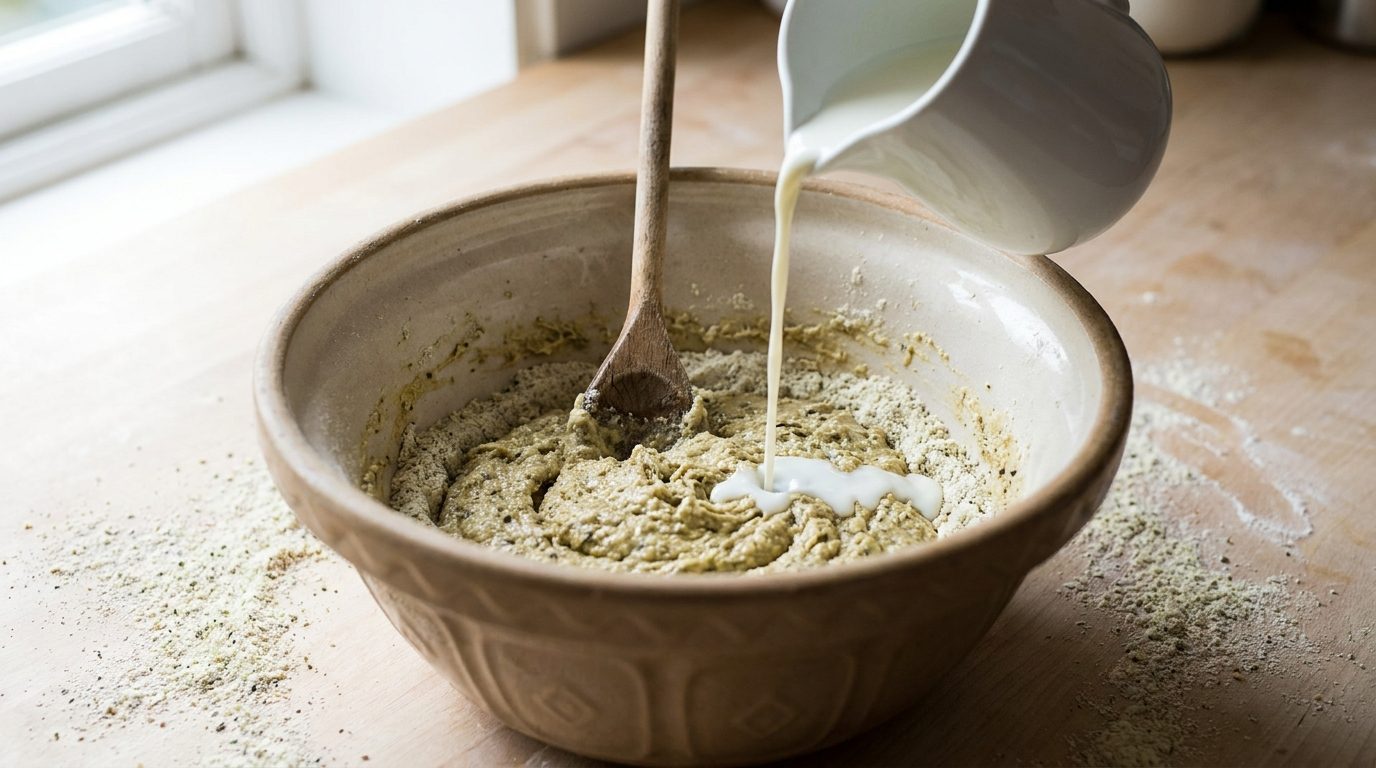
The most common hemp flour failure is not a green crumb or a strange flavour. It is dryness, and it happens because hemp flour absorbs considerably more liquid than the wheat flour it replaced while nobody adjusted for it.
Why hemp flour drinks so much
Wheat flour is mostly starch. It takes up water, gelatinizes in the oven, and sets into a structure. Hemp flour is mostly fibre and protein with very little starch, and the fibre is largely insoluble material from the seed hull.
Insoluble fibre holds water the way a sponge does: mechanically, in and around the particles, without dissolving and without forming a network. So hemp flour pulls water out of your batter and gives nothing structural back. Two things follow. Your dough gets stiffer than the recipe intended, and the crumb ends up drier, because the water is bound up in fibre rather than distributed through a starch and gluten matrix.
The fibre also keeps absorbing after mixing. Wheat doughs largely reach equilibrium quickly. A hemp-containing batter can visibly thicken over ten or fifteen minutes on the counter, which catches people out when they mix, get distracted, and come back to something they can no longer pour.
A starting adjustment
There is no universal ratio, because hemp flours vary in how much hull fibre they contain and how finely they are milled. But as a working starting point, for every quarter cup of wheat flour you replace with hemp flour, add roughly one to two tablespoons of extra liquid.
Start at the low end. It is far easier to loosen a stiff batter than to rescue a soupy one, and every extra spoonful of liquid also dilutes whatever leavening you have. Mix to the low figure, rest the batter, then look again.
The liquid itself does not have to be water. Milk, buttermilk, yogurt thinned slightly, plant milks and eggs all work, and the richer options help in a second way, since fat coats the fibre and mitigates some of the dryness on the palate even when the total moisture is unchanged.
Rest the batter, always
Give any hemp-containing batter or dough ten to twenty minutes after mixing and before shaping or baking. This is the highest-value habit in hemp baking and it costs nothing.
During the rest the fibre finishes hydrating. What you see at the end of the rest is what the oven will see, so you can judge consistency honestly and correct it. Skip the rest and the flour will keep drinking inside the oven instead, pulling moisture out of a crumb that has already begun to set.
For chemically leavened batters, mix the leavening in but keep the rest on the shorter end, since baking powder starts working on contact with liquid. For yeasted or refrigerated doughs, a longer rest is entirely fine and usually improves the result.
Wet batters and stiff doughs need different handling
Pourable batters, meaning pancakes, waffles, muffins and quick breads, are forgiving. You can see the consistency, adjust with a splash, and the extra moisture has somewhere to go. These are the best place to learn how your particular bag of hemp flour behaves.
Stiff doughs are less forgiving. Bread doughs, pastry and cookie doughs are held together by gluten or by fat, and hemp flour interferes with both. Adding a lot of extra water to a bread dough to compensate for hemp fibre gives you a slack dough with weak gluten, which spreads instead of rising. In stiff doughs the better lever is usually to lower the proportion of hemp flour rather than to keep pouring in liquid.
How to read the bowl
Trust texture over measurements. After the rest, check against these signs:
- Still too dry: the batter mounds and holds sharp edges, the spoon leaves a clean channel that does not close, or a dough cracks at the edges when you press it. Add liquid a tablespoon at a time.
- About right: a muffin batter falls off the spoon in thick ribbons that slowly merge. A dough feels tacky but not sticky and holds a shape without cracking.
- Overcorrected: the batter pours in a thin stream, or the dough smears rather than releases from your hand. You will get a gummy, sunken centre and pale sides. Add back a spoonful of the base flour, not more hemp flour.
A worked example
Take a standard muffin recipe calling for two cups of flour and one cup of milk. Replace half a cup of the flour with hemp flour. Half a cup is two quarter-cups, so the starting adjustment is two to four extra tablespoons of milk. Add two, mix, rest fifteen minutes, and look.
If the batter has thickened into something you would spread rather than spoon, add the third tablespoon and give it another two minutes. Bake at a slightly lower temperature than usual, because the extra protein browns faster, and check for doneness a few minutes early. The finished muffins should be moist at the centre with a slightly closer crumb than the all-wheat version, which is the expected trade and not a fault.
Write down the exact adjustment that worked, along with the brand of flour. Hemp flours differ enough between producers that the number you land on is specific to the bag in your fridge, and having it recorded turns the next bake from an experiment into a repeat. When you switch brands, treat the ratio as unknown again and start from the low end, since a darker, higher-fibre flour will always want more liquid than a finely sifted one. The rest of the technique material sits across our other guides.