
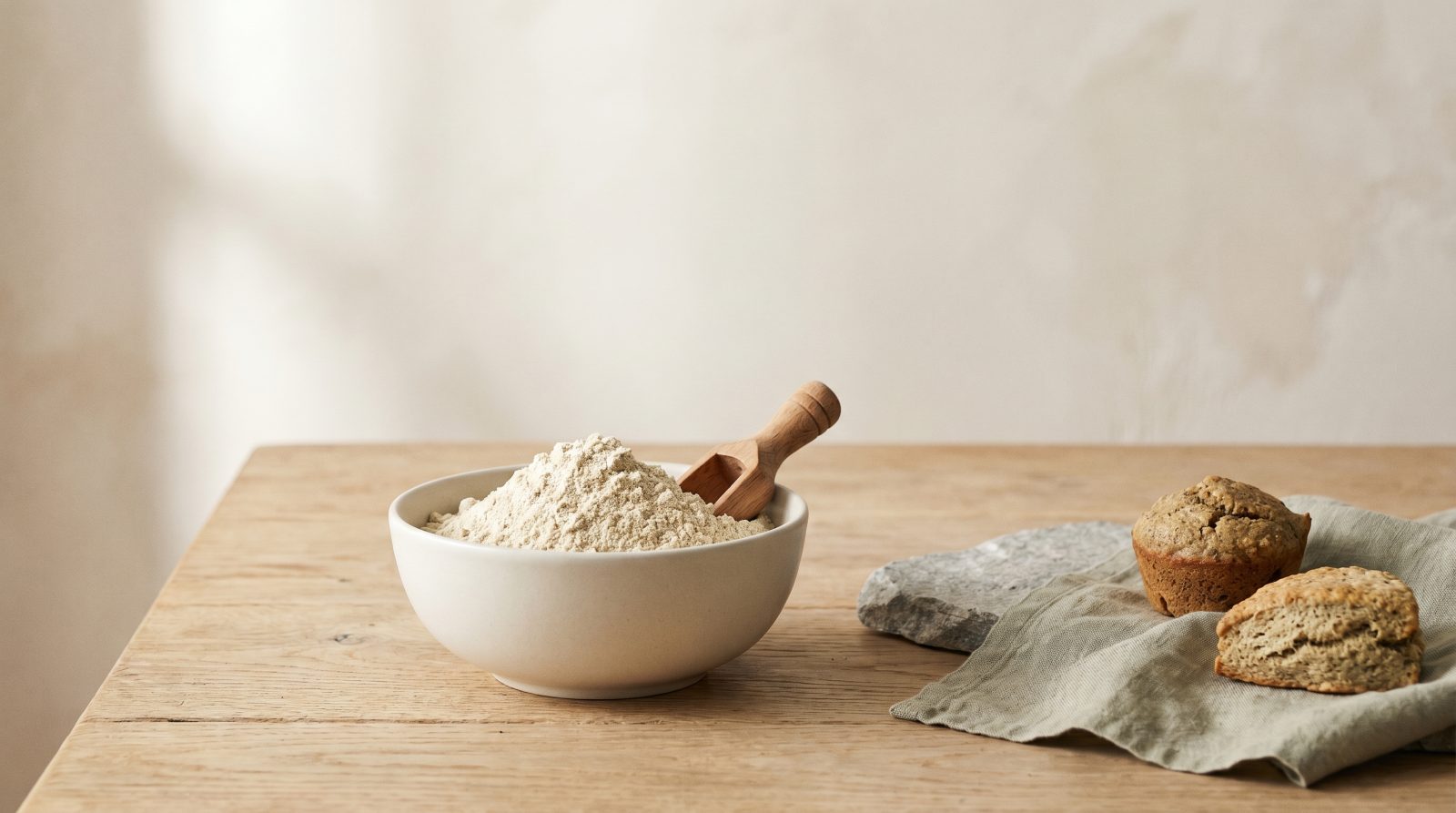
Hemp flour is hemp seed with most of the oil pressed out, milled into a fine, greenish-brown powder. What remains is mostly protein and fibre, with no gluten and very little starch, so it works best replacing part of the wheat flour in a recipe rather than all of it.
What is hemp flour?
Hemp flour is milled hemp seed press cake: the dry solid left behind when the oil is squeezed out of whole hemp seed. Whole seed is roughly 30 to 35 percent oil. Pressing removes most of it and concentrates what is left, mainly protein, fibre (much of it from the hull) and minerals. It is also sold as hemp seed flour or hemp protein flour.
How is hemp flour made?
Hemp flour is made by pressing the oil out of whole hemp seed, then milling, and usually sifting, the cake that remains.
- Pressing. Cleaned whole seed goes through a screw press (an expeller), the step that produces cold-pressed hemp seed oil, leaving a dense cake of seed solids, hull included.
- Milling. The cake is broken up and ground.
- Sifting. Many mills sieve out the coarsest hull fragments. Taken further, sieving or air classification separates the protein-rich fraction sold as hemp protein powder.
Pressing always leaves some oil behind: in ten commercial samples of cold-pressed hemp seed meal tested by University of Manitoba-led researchers, residual fat ran from about 8 to 15 percent. They found no evidence that the heat of pressing reduced the protein's digestibility.
Hemp flour nutrition: how much protein and fibre is in it?
On average, hemp flour is about 40 percent protein, 30 percent fibre and 10 percent fat by weight, though products vary widely. These figures come from House, Neufeld and Leson (Journal of Agricultural and Food Chemistry, 2010), who tested ten commercial samples of cold-pressed hemp seed meal from Western Canada.
| Component | Per 100 g (average) | Per 30 g (average) | Range per 100 g |
|---|---|---|---|
| Protein | 41 g | 12 g | 31–53 g |
| Fibre | 30 g | 9 g | 19–41 g |
| Fat | 10 g | 3 g | 8–15 g |
| Minerals (ash) | 6.7 g | 2 g | 4.6–8.7 g |
Fibre was measured as neutral detergent fibre, the insoluble cell-wall fraction, so a label's total dietary fibre may differ. The study did not report food-label calories. One UK miller's label for a sieved, high-protein hemp flour lists 300 kcal per 100 g (about 90 kcal per 30 g), but that flour has only 6.3 g of fat per 100 g, below the study's range, so oilier flours will be higher in calories. The flour samples varied far more than the whole-seed samples, which the researchers attributed to processing: how much oil the press removed and how the flour was sifted afterwards.
Even the low end is high for a flour: USDA FoodData Central lists whole-grain soft wheat flour at 9.6 g of protein per 100 g. Hemp protein contains all nine essential amino acids, which is why it is often called a complete protein, but lysine is in shortest supply. The study scored hemp seed meal's protein quality (PDCAAS) at 0.46 to 0.51 and concluded that hemp proteins rate equal to or better than certain grains, nuts and some pulses.
Hemp flour vs hemp protein powder: what's the difference?
Hemp protein powder comes from the same press cake as hemp flour, but it is milled finer and separated, usually by sieving or air classification, to remove much of the hull fibre and concentrate the protein. In a 2023 University of Manitoba study, two commercial hemp protein concentrates were about 54 and 66 percent protein, against roughly 41 percent for the average press-cake flour.
Flour keeps more fibre, which gives it bulk and makes it absorb liquid, so it suits doughs and batters. Protein powder is meant for smoothies and shakes. The two can stand in for each other in small amounts, but protein powder used in place of flour tends to make baked goods drier.
Is hemp flour the same as ground hemp hearts or hemp meal?
Hemp flour is not the same as ground hemp hearts, which keep their oil, but "hemp meal" usually means the same press cake, often ground more coarsely. Hemp hearts are shelled seeds, close to half fat by weight, so grinding them gives an oily powder that clumps and adds fat to a recipe instead of soaking up liquid. True hemp flour cannot be made at home without an oil press. Retail labels use "hemp meal" loosely, so check the fat line: under about 16 g per 100 g points to a pressed product, while 25 g or more means ground whole seed or hearts.
| Per 100 g | Protein | Fat | Fibre |
|---|---|---|---|
| Hemp flour (press cake) | 31–53 g | 8–15 g | 19–41 g |
| Hemp protein concentrate (2 products, 2023 study) | About 54–66 g | About 7–9 g | Not reported |
| Hemp hearts | 31.6 g | 48.8 g | 4 g (total dietary fibre) |
| Whole hemp seed | 24 g | 30 g | 32 g |
Sources: House et al. (2010), flour and whole seed, with fibre as neutral detergent fibre; Nosworthy et al. (2023), two commercial concentrates (retail protein powders vary); USDA FoodData Central, hemp hearts.
What does hemp flour taste like?
Hemp flour tastes nutty and earthy, with a faint grassy note. It is green-grey to brown and tints baked goods toward olive or tan, more visibly in white bread or sugar cookies than in chocolate or spice bakes. The flavour stays mild at a small share of the flour and grows with the proportion. It pairs well with chocolate, banana, oats, warm spices and whole-grain flavours.
Is hemp flour gluten-free?
Yes, hemp contains no gluten, but hemp flour is only reliably safe for people with celiac disease when it is labelled gluten-free. Canadian labelling guidance names wheat (including spelt and kamut), oats, barley, rye and triticale as gluten sources; hemp is not among them. The risk is cross-contact with cereal grains in the field, in storage or at the mill, and some hemp flours carry a "may contain cereals containing gluten" warning.
Health Canada accepts a gluten-free claim when gluten from cross-contamination stays at or below 20 ppm under good manufacturing practices. A 2014 analysis by Health Canada scientists found higher-fibre, naturally gluten-free flours without a gluten-free label the most likely to exceed that level, and advised people with celiac disease to use only higher-fibre flours labelled gluten-free in home-made foods. Hemp flour is high in fibre, so follow that advice and your doctor's or dietitian's guidance. For blends and binders, see our guide to hemp flour in gluten-free baking.
How do you use hemp flour in baking?
Use hemp flour to replace part of the wheat flour in a recipe, usually 10 to 25 percent, rather than all of it. The wheat supplies the gluten that lets a bake rise and hold together.
- Yeasted bread and pizza dough: 10 to 15 percent. More weakens the gluten network and the loaf rises less.
- Muffins, quick breads, pancakes and cakey cookies: 20 to 25 percent, since leavening and eggs carry more of the structure.
- Crackers: 25 to 40 percent, as they do not need to rise.
- Sponges and chiffon cakes: leave it out, or keep it under 10 percent.
To start, swap a couple of tablespoons of the flour in a muffin or pancake recipe, then work up. Add a little extra liquid, because the fibre absorbs water, and check the first bake a few minutes early, since the darker colour makes doneness harder to judge. The 10 to 25 percent rule has the full ratio table and liquid adjustment.
Health Canada advises that flour is a raw ingredient meant to be cooked before it is eaten, and not to add flour to foods that will not be cooked, such as milkshakes; at least one hemp miller labels its flour unpasteurized and not for eating raw. Use hemp flour in recipes that are baked or cooked, not in smoothies or no-bake treats.
How should you store hemp flour?
Keep hemp flour airtight, away from heat and light, and move it to the fridge or freezer once opened. It holds far less oil than hemp hearts, but that oil is mostly polyunsaturated (close to 80 percent of hemp seed fat, by USDA data), and polyunsaturated fats oxidize and turn rancid with warmth, light and air. Buy what you will use within a few months and smell it before each use: a sharp, bitter or paint-like smell means it has gone rancid.
Where can you buy hemp flour?
Hemp flour is sold in natural food stores, bulk food stores, some supermarkets and online, and directly by hemp processors and mills. When comparing bags, check that the ingredients read hemp seed and nothing else, that protein sits roughly between 30 and 50 g per 100 g (well above 50 g usually means a protein powder or concentrate), that it is labelled gluten-free if you need it to be, and that the best-before date is well ahead. To find producers, mills and retailers, browse our directory of hemp businesses.