
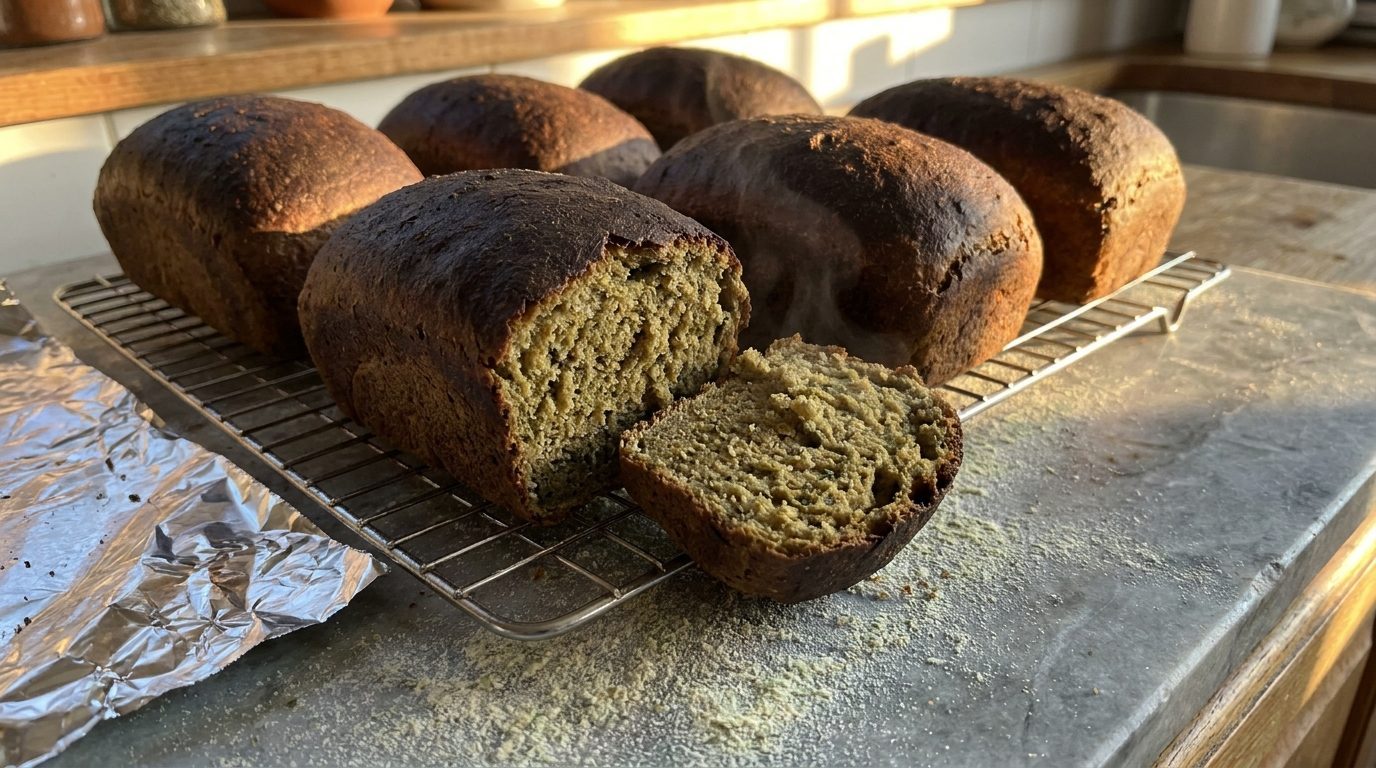
You pull the muffins at the usual time because the tops look perfect, cut one open, and find raw batter. Hemp flour reaches its finished colour long before it reaches its finished texture, and that gap causes most of the disappointing bakes.
Why the colour arrives early
Three things stack up. First, hemp flour starts dark. It is already green-brown in the bag, so it needs far less colour development to look done than a pale wheat batter does.
Second, browning reactions depend on protein reacting with sugars at heat, and hemp flour brings a lot of protein to the surface of your batter. More reactive material means faster colour.
Third, the residual oil in hemp flour concentrates at the surface as moisture leaves, and fat conducts heat efficiently into the crust. The exterior effectively cooks harder than the interior for a longer stretch of the bake.
The result is predictable. The outside signals done while the middle is still setting, and if you trust your eyes you underbake, while if you trust the timer you scorch.
Lower the temperature rather than shortening the time
The instinct is to bake for less time. That is the wrong lever, because the interior genuinely needs those minutes. What you want is a gentler heat applied for at least as long.
A useful starting adjustment is to drop the oven roughly 15 degrees Celsius, or about 25 degrees Fahrenheit, below what the original recipe specifies, then extend the bake and start checking a few minutes past the original time. A moderate oven gives the centre time to set before the crust runs away with the colour.
This works well for muffins, loaves, cakes and cookies. It works less well for anything that relies on a hot initial blast for lift or crisping, such as pizza or thin crackers, where a different tactic is needed.
Tenting, pan choice and rack position
When lowering the temperature is not enough, or not possible, shield the surface instead:
- Tent with foil. Once the top hits the colour you want, lay a loose sheet of foil over it, shiny side up, and continue baking. Do not seal the edges; you want to block radiant heat, not steam the crust.
- Choose light pans. Dark metal absorbs more heat and pushes the crust harder. Light-coloured or dull aluminium pans, or glass, give a gentler bake for the same oven setting.
- Move down, not up. The top of the oven is hotter and the element is closer. Bake hemp-heavy items on a middle or lower-middle rack.
- Use a second sheet. Double-panning cookie sheets insulates the base and prevents the underside from darkening before the top is ready.
- Skip convection, or reduce it. Fan-forced heat accelerates surface drying and browning. If your oven only does convection, drop the temperature further.
Judging doneness when colour lies
You need cues that are not visual. Build the habit of using at least two:
A skewer or thin knife into the centre should come out with a few dry crumbs and no wet batter, though note that hemp-containing crumb stays slightly moister than all-wheat crumb even when fully baked, so a completely bone-dry skewer often means you have gone too far.
Press the centre gently. A finished cake or muffin springs back and the surface feels set rather than yielding. Loaves sound hollow when tapped underneath, and pull away slightly from the sides of the tin.
For anything substantial, an instant-read thermometer removes the guesswork entirely. Most cakes and quick breads are done in the low nineties Celsius at the centre, and a thermometer is far more honest than a crust that browned early.
Sweeteners and dairy push it further
The recipe around the hemp flour also matters. Liquid sugars such as honey and maple syrup brown considerably faster than granulated sugar. Milk and buttermilk contribute their own sugars and proteins to the reaction. A recipe that pairs hemp flour with honey and buttermilk will darken very quickly indeed, and needs both a lower temperature and a tent.
If you have a recipe that keeps scorching despite adjustments, swapping some of the honey for granulated sugar is often a more effective fix than fiddling with the oven again.
When dark stops being attractive
A well-browned hemp crust tastes good. It is nutty and slightly toasted, and it is part of why hemp works so well in savoury baking. Pushed too far it turns bitter and acrid, because the polyunsaturated fats and the protein degrade rather than caramelize, and that bitterness is not subtle. Once you taste it, the batch is not recoverable.
Aim for a warm, even brown with no dark rims at the edges of muffin tops or the corners of a tray bake. If the edges are darkening much faster than the centre, that is a heat distribution problem, and rotating the pan halfway through the bake solves most of it.
Make one change at a time and record it. Drop the temperature by 15 degrees Celsius on your next batch, leave everything else alone, and note the new bake time and how the crumb turned out. Once you have that number for one recipe it usually transfers reasonably well to others at similar hemp proportions, and you stop guessing. The related adjustments for liquid, ratio and texture are covered across the rest of our baking guides.