
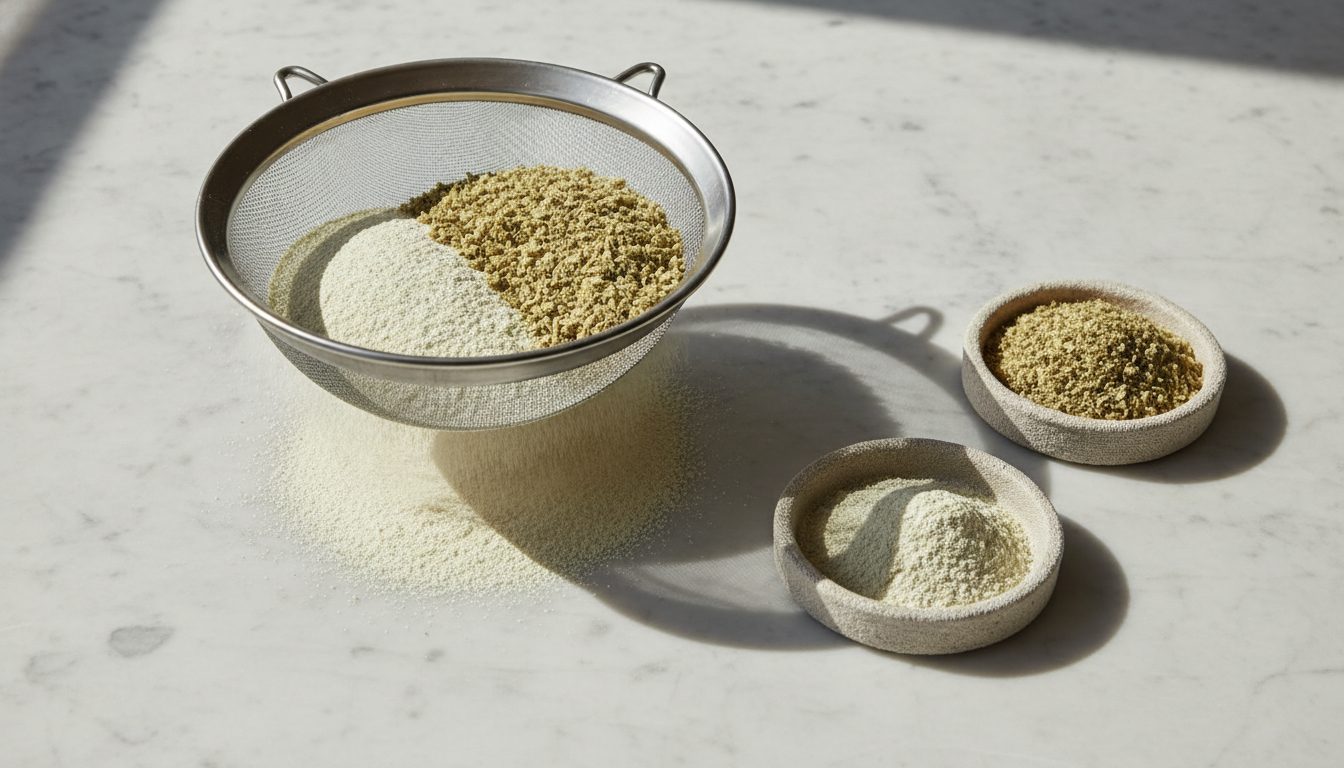
Hemp flour is marketed as a protein ingredient, but look at almost any nutrition panel and the fibre figure sits right beside the protein figure, often matching or beating it. That fibre is the single biggest reason hemp flour behaves the way it does.
Why hemp flour ends up so high in fibre
Hemp flour is milled from press cake, the compressed solids left after hemp seed oil is squeezed out. Removing the oil removes a large share of the seed's weight, and everything that stays behind becomes proportionally more concentrated. Protein rises, and so does fibre.
Most of that fibre comes from the seed hull. Hemp hulls are tough and woody, and even after fine milling, fragments of hull remain suspended in the flour. How much depends on the producer. A flour milled from whole-seed cake and sifted lightly will be high in fibre and darker in colour. A flour milled from dehulled cake, or sifted aggressively, will run lower in fibre and higher in protein. This is why two bags labelled hemp flour can have noticeably different panels.
How much fibre are we actually talking about?
Figures vary too much between brands to quote a single number honestly, but the general shape is consistent: total fibre in hemp flour commonly lands somewhere around a quarter to a third of the flour's weight. For comparison, whole wheat flour sits far below that, and white flour is lower again by a wide margin.
The practical consequence is that a couple of tablespoons of hemp flour can contribute more fibre than a slice of whole-grain bread. That is genuinely useful, and it is also why hemp flour cannot be swapped in freely. You are not adding a flour with a bit of fibre attached; you are adding a fibre ingredient that happens to contain protein.
Soluble or insoluble?
Both are present, but insoluble fibre dominates. That is the hull talking: cellulose, hemicellulose and lignin, the structural material of the seed coat. Insoluble fibre does not dissolve or form a gel. It adds bulk, holds water mechanically, and speeds material through the gut.
The smaller soluble fraction behaves differently. Soluble fibre disperses in water, thickens, and slows the passage of food out of the stomach, which is part of why fibre-rich meals tend to feel more filling than their calorie count suggests.
For a baker, the split matters because insoluble fibre absorbs water without contributing viscosity or stretch. That is exactly why a batter with hemp flour in it can look thick and still bake up crumbly. The flour has taken up liquid without building any structure with it.
What that means in a real recipe
Fibre per 100 grams is an abstraction. Fibre per muffin is not. Work it through: if you replace half a cup of the flour in a twelve-muffin batch with hemp flour, each muffin carries roughly two teaspoons of it. That is a meaningful bump on top of whatever the base flour provides, but it is not a fibre supplement, and it will not on its own move someone from a low-fibre diet to a high-fibre one.
The recipes where hemp flour genuinely shifts your daily intake are the ones where it makes up a larger share of a single serving: a bowl of porridge with a heaped spoonful stirred in as it cooks, a stack of pancakes or a flatbread where hemp is a large share of the flour, a cracker dough where hemp is a quarter of the flour and you eat a dozen crackers. Keep it to cooked foods: Health Canada advises that flour is a raw ingredient meant to be cooked before it is eaten.
Introduce it gradually
A sudden jump in fibre intake is the most common complaint from people who start baking with hemp flour enthusiastically. Bloating, gas and cramping are the usual outcome, and they generally settle if you scale up over a week or two rather than overnight.
- Start with a small proportion in one recipe rather than converting your whole kitchen at once.
- Drink more water. Insoluble fibre works by holding water, and it cannot do that if there is none available.
- Spread it across the day instead of eating an entire batch of high-hemp muffins in one sitting.
- If you have a diagnosed digestive condition, or you have been advised to follow a low-fibre or low-residue diet, talk to your clinician before adding a concentrated fibre ingredient.
The fibre is also why your batter changed
Every complaint people have about baking with hemp flour traces back to this one property. Dry crumb, dense texture, batter that stiffens while it sits, a loaf that will not rise: all of it is fibre absorbing liquid and refusing to build gluten with it. The fix is always some combination of using less hemp flour, adding more liquid, and letting the batter rest before it goes in the oven, which we cover in more depth across the rest of the site.
When you are comparing bags in a shop, ignore the front of the package and turn it over. Find the serving size, convert everything mentally to a common basis such as 30 grams, and read fibre and protein together. A flour with high fibre and moderate protein is the better baking ingredient, because the fibre is what gives structure-free bulk and keeps the flavour mild. A flour with low fibre and high protein is closer to a protein powder, will taste stronger, and will dry out a crumb faster. Neither is wrong, but knowing which one you have in the cupboard will explain most of what happens next in the oven.