
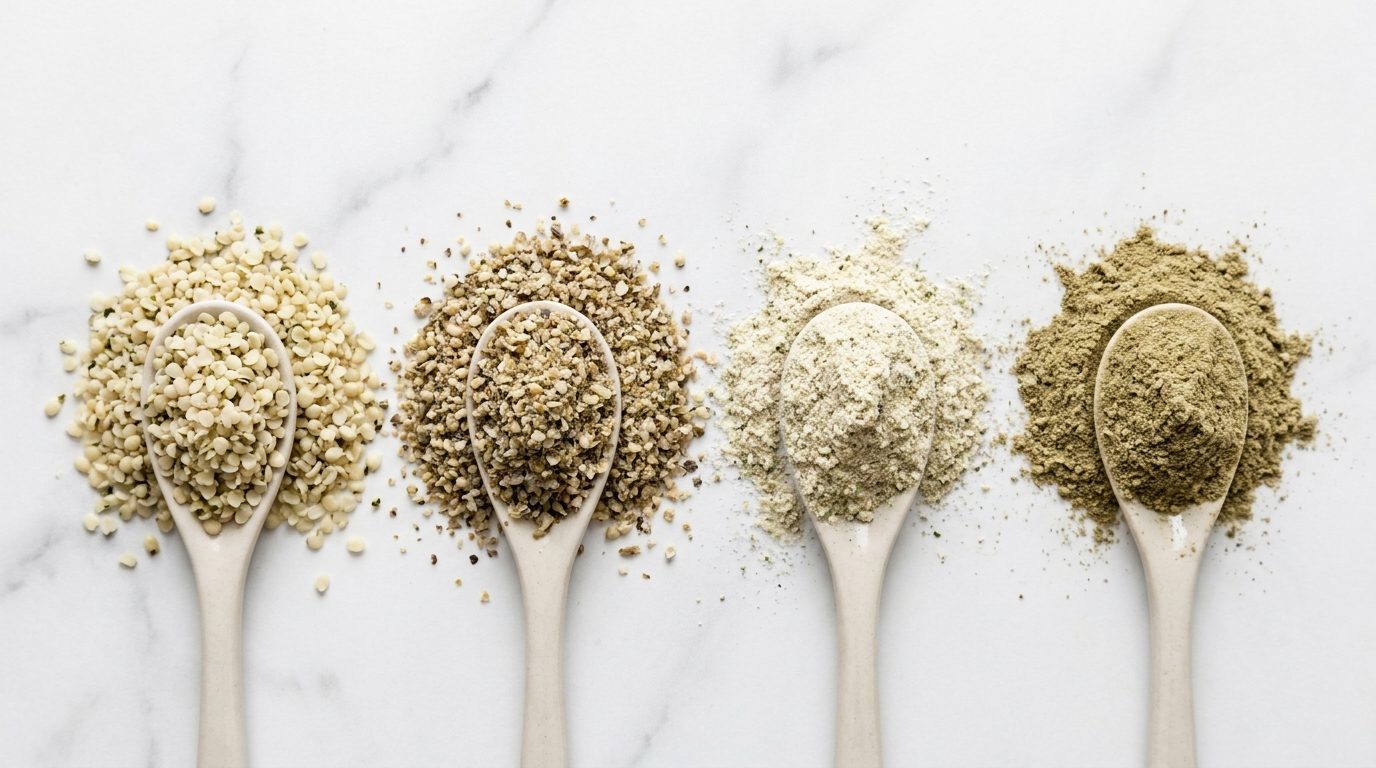
Hemp hearts, hemp meal, hemp flour and hemp protein powder all come from the same seed, and the packaging rarely explains how they differ. The distinction comes down to two things: whether the oil was pressed out, and how finely what remains was ground.
One seed, two parts, three decisions
A hemp seed is a hard, fibrous outer hull wrapped around a soft, oily kernel. Every hemp food on the shelf is the outcome of three processing decisions: whether the hull comes off, whether the oil is pressed out, and how finely the leftovers get milled. Once you can read a package in those terms, the names stop being marketing language and start being fairly literal descriptions.
Hemp hearts are the shelled seed and nothing else
Hemp hearts, also sold as hulled or shelled hemp seed, are kernels with the hull cracked away. They are pale green, soft enough to crush between your fingers, and roughly half fat by weight. That fat is exactly why they cannot stand in for flour. Run them through a food processor and you do not get powder, you get a paste, for the same reason almonds turn into almond butter long before they turn into anything dry.
Hemp hearts belong on top of things and inside things: stirred into porridge, scattered over a salad, folded into a dough for texture. They will not thicken a batter, bind a patty, or replace part of your wheat flour.
Hemp seed meal is what the oil press leaves behind
Cold-pressed hemp seed oil is made by squeezing the seed. The oil runs off and a dense, dry cake of compressed solids stays in the press. That press cake is the raw material for everything else. Broken up and coarsely ground, it becomes hemp seed meal, sometimes labelled hemp cake, seed cake or expeller meal.
Because most of the oil is gone, meal is concentrated protein and fibre with a modest amount of residual fat. It is also gritty. Meal works in a rustic loaf, a granola, or a bowl of porridge where texture is welcome, but it will make a cake feel sandy on the tongue.
Hemp flour is that same cake, milled fine and sifted
Hemp flour is press cake taken two steps further: milled to a fine powder and, in the better products, sifted to pull out the coarsest hull fragments. What you get is a soft, dark green-brown flour that smells nutty and faintly grassy. Compared with wheat flour it carries far more fibre and protein and almost no starch, and it contains no gluten whatsoever.
That composition explains everything hemp flour does in a recipe. It absorbs a lot of liquid because of the fibre. It adds bulk without adding structure, because there is no gluten and little starch to gelatinize. And it tints the crumb a green or grey-green shade, because the colour compounds from the hull do not disappear in the oven.
Hemp protein powder is flour with fibre screened out
Hemp protein powder starts from the identical press cake. The difference is a sieve. Milling and air classification remove a portion of the coarse hull fibre, which raises the protein percentage of what stays behind. Higher-percentage protein powders have simply had more fibre taken away.
This is why the two products can look nearly identical in the bag yet behave differently in a bowl. The dividing line between hemp flour and hemp protein powder is a screen size, not a different plant.
| Product | What it is | Texture | Typical use |
|---|---|---|---|
| Hemp hearts | Shelled kernel, oil intact | Soft, oily, visible seeds | Topping, folding in whole |
| Hemp seed meal | Coarsely ground press cake | Gritty, sandy | Porridge, rustic breads, granola |
| Hemp flour | Finely milled, sifted press cake | Soft, faintly fibrous powder | Partial replacement for wheat flour |
| Hemp protein powder | Press cake with fibre screened out | Fine, slightly chalky | Shakes, smoothies, small baking additions |
How to tell what you actually bought
Naming is inconsistent between producers, so the front of the bag is the least reliable guide. Use these checks instead:
- Compare fibre with protein on the panel. If fibre is close to protein or higher, you are holding a flour or a meal. If protein clearly dominates, it is a protein powder.
- Rub a pinch between your fingers. Flour feels soft with a trace of grit. Meal feels obviously sandy. Protein powder feels fine and slightly slippery.
- Look for whole seeds. Any visible intact kernels mean hearts, not flour.
- Read the ingredient line. Phrases like hemp seed cake, partially defatted hemp seed, or hemp protein all point to press-cake products. Hulled hemp seed points to hearts.
Which one belongs in your kitchen
If you want to bake, buy the finely milled flour and use it as a partial replacement rather than a wholesale substitute for wheat. If you want texture and fat with almost no processing, buy hearts. If your goal is protein in a shake, buy the powder and accept that it is a poor baking flour. Most people who cook regularly end up keeping hearts and flour and skipping the other two entirely, and you can read more about how each behaves across our other hemp flour guides.
One last practical note. All four products carry residual polyunsaturated oil, which means every one of them goes stale faster than wheat flour does. Buy the smallest quantity that matches how quickly you actually cook, keep it sealed in the fridge or freezer rather than the pantry, and open the bag and smell it before every use. Fresh hemp smells green and nutty; anything sharp, bitter or paint-like means the oil has turned and the bag should go.