
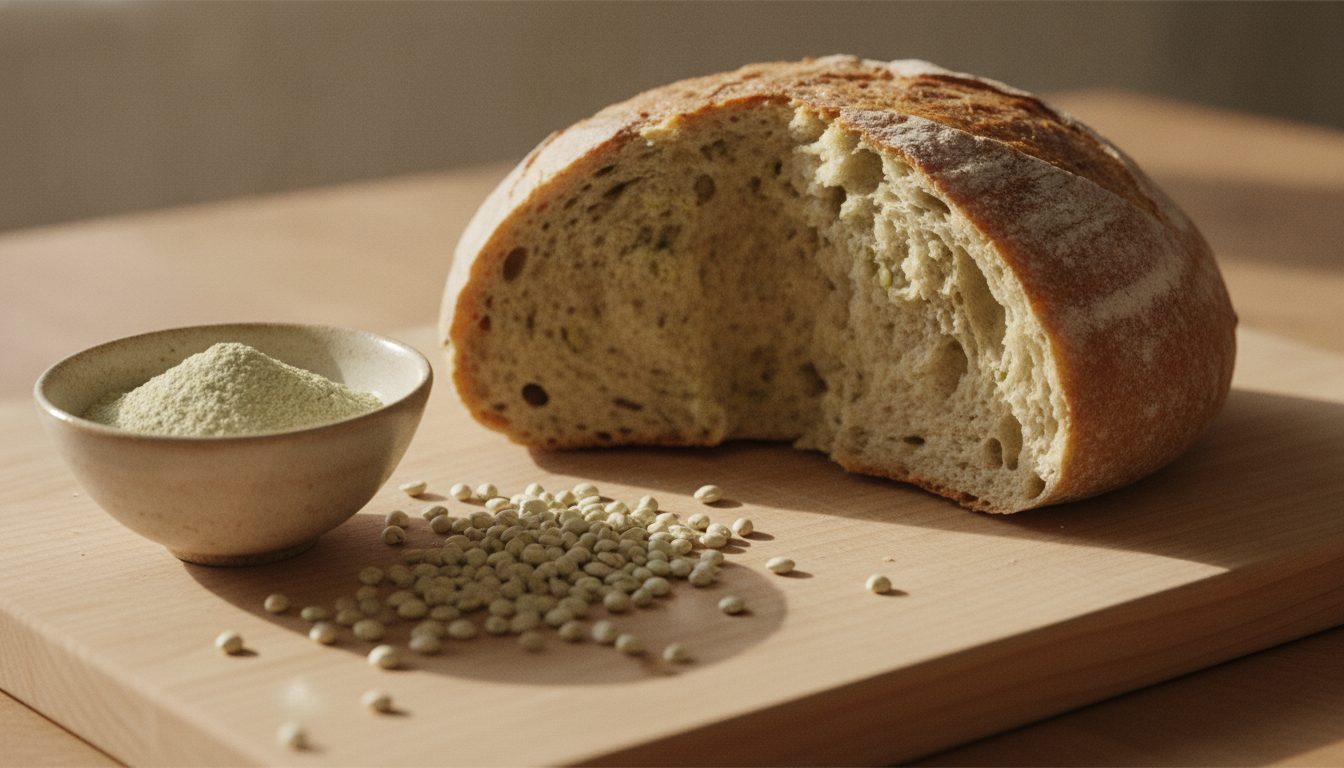
Hemp turns up on almost every list of plant foods that count as a complete protein. The claim is accurate, but it answers a narrower question than most people think, and it says almost nothing about how much protein you get from a muffin.
What complete protein actually means
Your body can manufacture most amino acids for itself. Nine it cannot, and those nine have to arrive in food. A protein source is called complete when it supplies all nine in reasonable proportions relative to human requirements. Animal proteins generally qualify. Many single plant foods do not, because they run short on one particular amino acid, which then limits how much of the rest your body can put to use.
Hemp contains all nine. That is the entire basis of the complete protein claim, and it is a fair statement about the amino acid profile of hemp seed protein.
What hemp's amino acid profile looks like
Hemp protein is generally well balanced, with a notably high arginine content and reasonable levels of the sulphur-containing amino acids methionine and cysteine, which are the ones many legumes are short on. Its own weak point tends to be lysine, which sits lowest relative to reference patterns and is therefore usually described as hemp's limiting amino acid.
Limiting does not mean absent. It means that if hemp were the only protein you ate all day, lysine would be the first constraint you hit. In practice almost nobody eats a single protein source, and lysine is abundant in exactly the foods most people pair with hemp anyway: lentils, beans, chickpeas, peas, dairy, eggs, fish and meat.
Edestin, albumin and digestibility
Two proteins account for most of what is in a hemp seed. Edestin, a globulin, makes up the large majority, with albumin making up most of the remainder. Both are storage proteins, and both are generally regarded as readily digestible, which matters because a protein your body cannot break down efficiently contributes less than its label figure suggests.
Hemp also has no gluten, no soy, and none of the common allergen proteins found in dairy or tree nuts, which is a large part of why it appears in so many free-from products. That is a compositional fact rather than a nutritional advantage, but it is often the deciding one for the person buying the bag.
Complete does not mean abundant
Here is where the marketing and the kitchen diverge. Hemp flour is milled press cake, and its protein content sits well below that of hemp protein powder, which has had fibre deliberately screened out to raise the percentage. Hemp flour is roughly a fibre-and-protein ingredient in similar measure.
Now put that into a recipe. Because hemp flour has no gluten, it usually makes up a minority of the total flour in anything you want to rise. If it is, say, a fifth of the flour in a twelve-muffin batch, each muffin picks up a couple of teaspoons of hemp flour, and only part of that couple of teaspoons is protein. The honest conclusion is that hemp flour improves the protein profile of baked goods at the margin. It does not turn a scone into a protein bar, and no amount of complete protein language changes that arithmetic.
Where the completeness genuinely helps
The claim earns its keep in two situations. The first is a plant-based diet with limited variety, where a single ingredient that covers all nine essential amino acids reduces the amount of planning required. The second is any application where hemp is a large share of the meal rather than a minor flour component:
- A heaped spoonful stirred into porridge while it cooks
- Pancakes, crackers and flatbreads, where hemp flour can be a larger share of the flour
- Baked energy bars or granola, where hemp can be a third or more of the dry mix
- Savoury patties and fritters, where hemp binds and contributes protein at the same time
Each of those is cooked, and that matters: Health Canada advises that flour is a raw ingredient meant to be cooked before it is eaten, and not to add it to foods that will not be cooked, such as milkshakes. For a smoothie or overnight oats, use hemp hearts instead.
In those uses the amino acid profile matters, because hemp is doing real nutritional work rather than seasoning a wheat-based product.
Do you need to combine proteins at every meal?
No. The older advice about carefully pairing complementary proteins within a single sitting has been relaxed considerably. What matters is the overall pattern across a day and a week. Eat legumes, grains, seeds and nuts across your meals and the amino acid gaps in any one of them get filled by the others without deliberate effort.
That reframes the question usefully. Instead of asking whether hemp flour is complete, ask whether it adds protein you would not otherwise be eating, in a form you enjoy often enough to keep buying. For most home bakers it does, modestly and reliably, alongside a substantial amount of fibre. For a fuller picture of what else is on the panel, the nutrition material across the rest of the site goes into the fat, fibre and mineral side.
If protein content is your actual priority, buy on the panel rather than the front of the bag. Compare protein grams at a fixed 30 gram basis across the products in front of you, and notice how much fibre is sitting alongside it. High protein with low fibre means you are effectively looking at a protein powder, which will taste stronger and dry out baked goods faster. Moderate protein with high fibre means a genuine baking flour. Choose according to whether you are trying to feed a shaker bottle or a mixing bowl.